
What Is Conversational Hypnosis? A Guide for Practitioners
For coaches, hypnotists and therapists, conversational hypnosis is changework done inside a normal conversation with your client, on something your client chooses. You listen for their own words, notice the loop they're already running, and help them change it from the inside, together. Then you check the change with them.
This guide is written for the practitioner's side of the chair.
What is conversational hypnosis, in plain words?
So let's start simple. It's hypnosis without a separate hypnotist mode. There's no "join me in my office," no "close your eyes, sleep now." It's just me, here with the person, holding space, asking questions and noticing what I notice.
When people come to you with a problem, they're already in a kind of trance. They're in their own loop. They believe something, they imagine it, their body responds as though it's happening, and that becomes their experience, over and over. A lot of training teaches you to break that trance and build a new one with an induction and a script. That's a solid foundation. And still, why wouldn't we just utilize what's already there?
Now, if you search the term, you'll find a very different definition. The encyclopedia entry for covert hypnosis says it is "also known as conversational hypnosis," and describes trying to reach a person's unconscious mind without telling them. The same entry adds that conversational hypnosis "can also be done overtly." That's the version people worry about.
The practitioner version runs the other way. Your client knows they're in a session. They choose what to work on, they can stop at any time, and you check the change together at the end. The word "conversational" describes how the work sounds. It feels like a natural conversation because it is one.
If you want an academic anchor, Dan Short's 2018 review in the American Journal of Clinical Hypnosis describes conversational hypnosis "as distinct from traditional forms." He builds his definition on three ideas that are common in the hypnosis literature: focusing, engaging and inciting.
How is it different from formal hypnosis?
| Formal hypnosis, as it's often taught | Conversational hypnosis, as I teach it | |
|---|---|---|
| How it starts | An induction, a set process that leads into trance | A question about something your client chose to talk about |
| Eyes | Usually closed | Open or closed; hypnosis isn't dependent on eyelids |
| Where the trance comes from | A new state the session sets out to create | The trance your client is already in, around the problem |
| Whose words | The script's words | Your client's own words |
| Who leads | The hypnotist, toward a planned state | Your client; you follow what they give you |
So where's the trance in a conversation? It happens when a question makes your client go inside to find the answer. If I ask you what two plus two is, nothing much happens. It's automatic. If I ask you what color the number two is, you have to go looking. Right? That search is trance, and you can see it happen with someone's eyes wide open.
A lot of this grows from Milton Erickson's work. Erickson talked about hypnosis as a learning state, where the unconscious mind offers the person new ideas, new beliefs and new actions they can start taking on.
And if you trained in formal hypnosis first, I'm not asking you to get rid of what you know. I'd only ask you to focus on this for a while, and bring the other tools back in later.
What does conversational hypnosis look like in a session?
From the outside, it looks like two people talking. Underneath, you're doing three things.
Listening for your client's own words
The model I developed for this is called LORRA: Listen, Observe, Repeat, Relate, Ask. You listen, you notice what shows up in their face, breath and body, you repeat back their exact words, and you relate two things they said with a question.
The words that matter are their words, the ones they use for the problem. And repeat is the step people skip most. Repeating what they gave you is what pulls them back in and keeps them there.
Noticing the doorway
A doorway is a charged moment. Your client says a word with extra weight, their body shifts, or a part of them shows up ("part of me wants to, part of me doesn't"). When you ask about that moment, you get access to the loop underneath it.
Working with the Loop
The Loop is based on James Tripp's Hypnosis Without Trance model. It's a circle: belief, then imagination, then the body's response, then the experience, which feeds back into the belief.
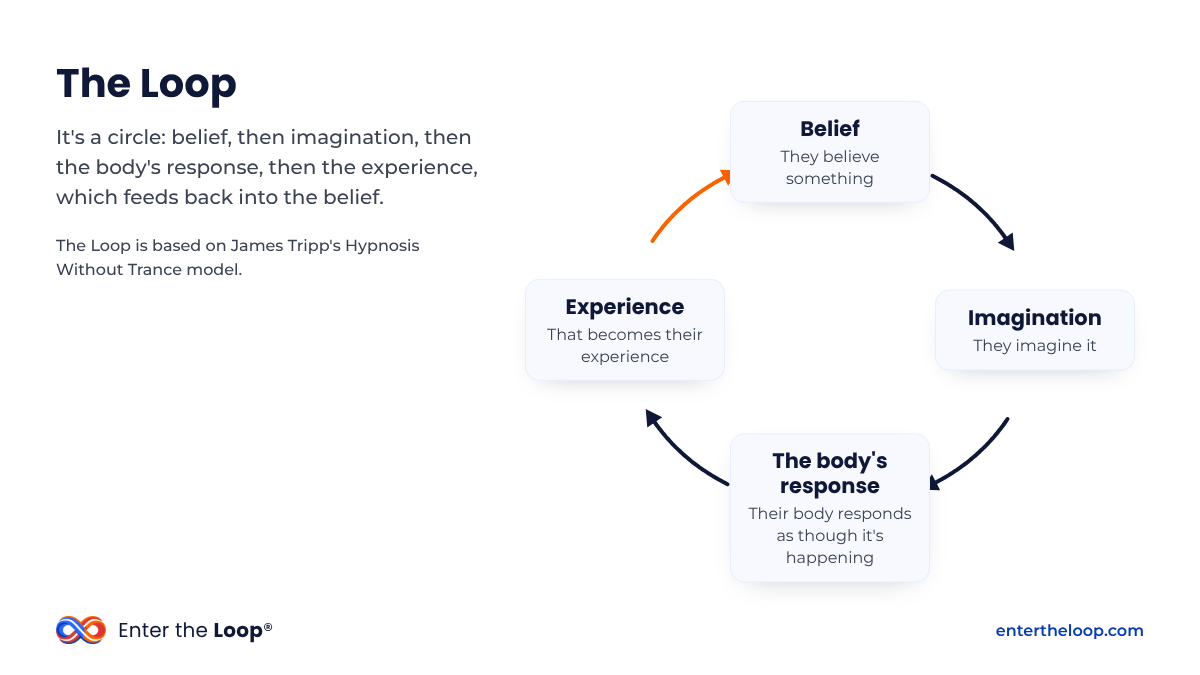
Say a client tells you they feel stuck in a well. They're sitting across from you, or on Zoom, imagining a well, and their body is responding as though they're in one. That image is something you can ask about, gently, with their permission. A question I teach here is a James Tripp line: "What do you notice now?" It brings them right back into the experience part of the loop.
The whole time, your client is choosing where it goes. The consent side of this is in is conversational hypnosis manipulation?
What are the limits of conversational hypnosis?
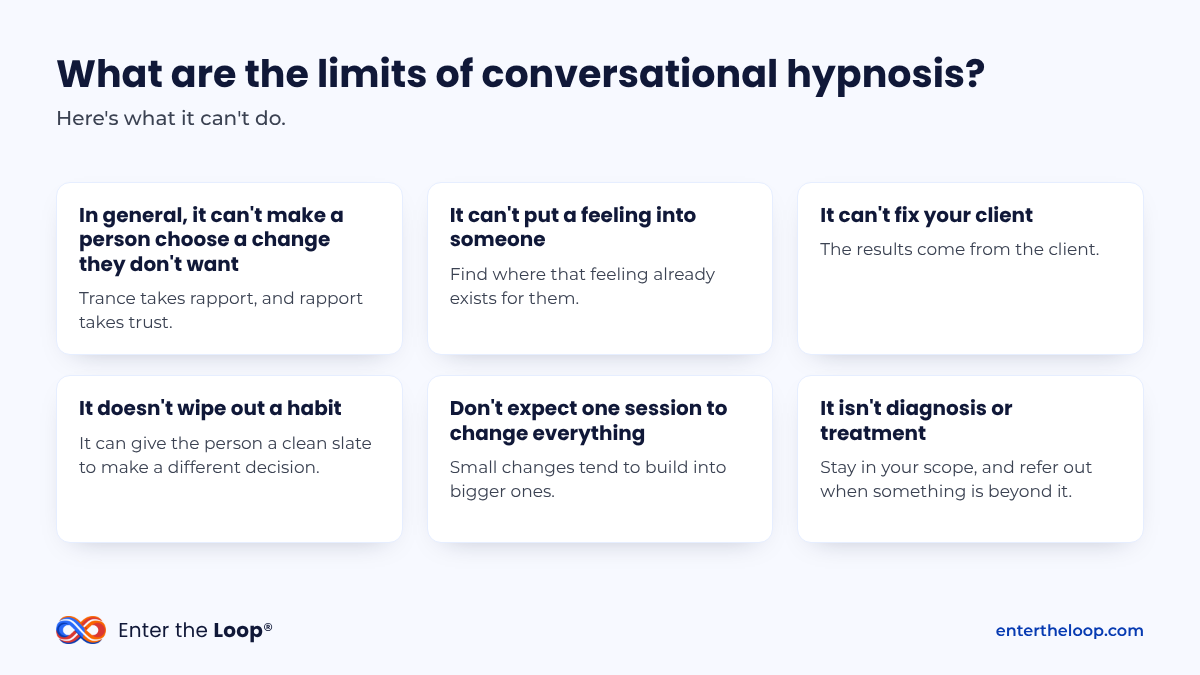
Here's what it can't do.
- In general, it can't make a person choose a change they don't want. Trance takes rapport, and rapport takes trust. Break the trust and the trance goes with it.
- It can't put a feeling into someone. We can't make somebody feel a certain way. What we can do is find where that feeling already exists for them and help them bridge to it.
- It can't fix your client. The results come from the client. Their own mind supplies the building blocks of the solution, and your job is to help them put it together.
- It doesn't wipe out a habit. What it can do is give the person a clean slate to make a different decision, like fresh snow on a ski slope. The decision is still theirs.
- Don't expect one session to change everything. Small changes, each one tied back to the original problem, tend to build into bigger ones.
- It isn't diagnosis or treatment. Stay in your scope. If someone brings you a medical or mental-health condition and your license doesn't cover it, refer them to someone whose license does.
Nicholas Heger, our Lead Mentor, puts the honest version of this well. He's talked about the kind of hypnotist who promises to fix any problem in the universe in twenty minutes, and his take: "That's a lot. And it's not really ethical."
Does conversational hypnosis work?
Short's review defines the approach and ends with recommendations for future research. I don't know of a trustworthy success rate for conversational hypnosis, and I'm not going to make one up. So you find out in your own sessions, with your own clients, by checking.
Here's the check, in plain words:
- Take a baseline. Before you start, get how the problem shows up for your client right now: a number from 0 to 10, their exact phrase, an image or a body response.
- Run the soft test. After the work, ask them to think about the next time the original problem would come up, and notice what's different.
- Run the hard test. Ask them to bring the original problem up as if it's happening right now.
- Let your client tell you. Compare it to the baseline together.
What you're checking is whether your client responds differently when the old problem shows up again. That's something you can check with your client, session by session. There's more on this in how do you know if hypnosis worked?
What about the worry that it's manipulation?
It can be used that way, like any communication skill. The practitioner version is built around your client's choice, consent and a shared check, and there's a whole post on it: is conversational hypnosis manipulation?
FAQ
Why do hypnotists snap their fingers?
The snap tends to work because the person already expects something to happen when they hear it. That expectation is a belief. The belief fires an image, the image fires a response in the body, and that becomes the experience. That's the Loop, from James Tripp's Hypnosis Without Trance model. So the snap is a cue the person already expects, not magic.
What can't hypnosis do?
In general, it can't make a person choose a change they don't want, and it can't put a feeling into someone that isn't already theirs. It can give a person a clean slate to make a different decision about a habit, and the decision is still theirs. And there's no promise that anything will change, which is why you test the change with your client.
Does my client have to close their eyes?
No. Hypnosis isn't dependent on eyelids. In conversational work your client's eyes are often open, and trance shows up when a question sends them inside to search for the answer. Some people close their eyes on their own while they're searching, and that's fine too. You follow what they do.
Is conversational hypnosis the same as Ericksonian hypnosis?
It grows from that tradition. Milton Erickson's indirect, client-centered style is one of its roots, and Dan Short's 2018 review traces that history before defining conversational hypnosis on its own terms. Enter the Loop® also draws on NLP, Clean Language (from David Grove's work) and James Tripp's Hypnosis Without Trance.
Sources
- Dan Short, "Conversational Hypnosis: Conceptual and Technical Differences Relative to Traditional Hypnosis," American Journal of Clinical Hypnosis 61(2), 125 to 139, October 2018 (PMID 30260303): https://doi.org/10.1080/00029157.2018.1441802
- Wikipedia, "Covert hypnosis" (read November 16, 2026): https://en.wikipedia.org/wiki/Covert_hypnosis
- The Loop: James Tripp, Hypnosis Without Trance: https://hypnosiswithouttrance.com/
About the author
Timothy September created Enter the Loop®, a conversational hypnosis training for coaches, hypnotists and therapists. 160+ practitioners trained in Enter the Loop®. 1,000+ students taught, including 4 years as Head of Coaching at Mike Mandel Hypnosis.
At the free Open Session (on Zoom, the third Friday of every month, 1 to 3 PM ET), you can see this work done live. When a volunteer works with me, they choose what to work on and can stop at any time, and at the end of their turn I check with them, live, whether anything changed. Camera off is fine. If you'd like to go further after that, the plans are at entertheloop.com/join. I look forward to seeing you there.
See this work done live, with a real person, at the free monthly Open Session on Zoom.


