
Is Conversational Hypnosis Manipulation? An Honest Answer
It can be. Any skill that helps you listen closely and choose your words can be used to steer a person somewhere they didn't choose to go. What makes the practitioner version different is how it's built: your client chooses what to work on, consent sits inside the method, your client can stop, and you check the change together.
Can conversational hypnosis be used to manipulate people?
Yes, it can. A good question, a well-placed pause, a story told at the right moment: each of those can help a person, and each of them can be used to push a person where they never asked to go. Conversational hypnosis is a set of communication skills, and whether they help or harm depends on the person using them and how.
It doesn't help that the first definitions you find online lean toward the fear. The encyclopedia entry for covert hypnosis says it is "also known as conversational hypnosis." The same entry adds that conversational hypnosis "can also be done overtly." So if your client looked the term up before they met you, they may walk in wondering what you're going to do to them.
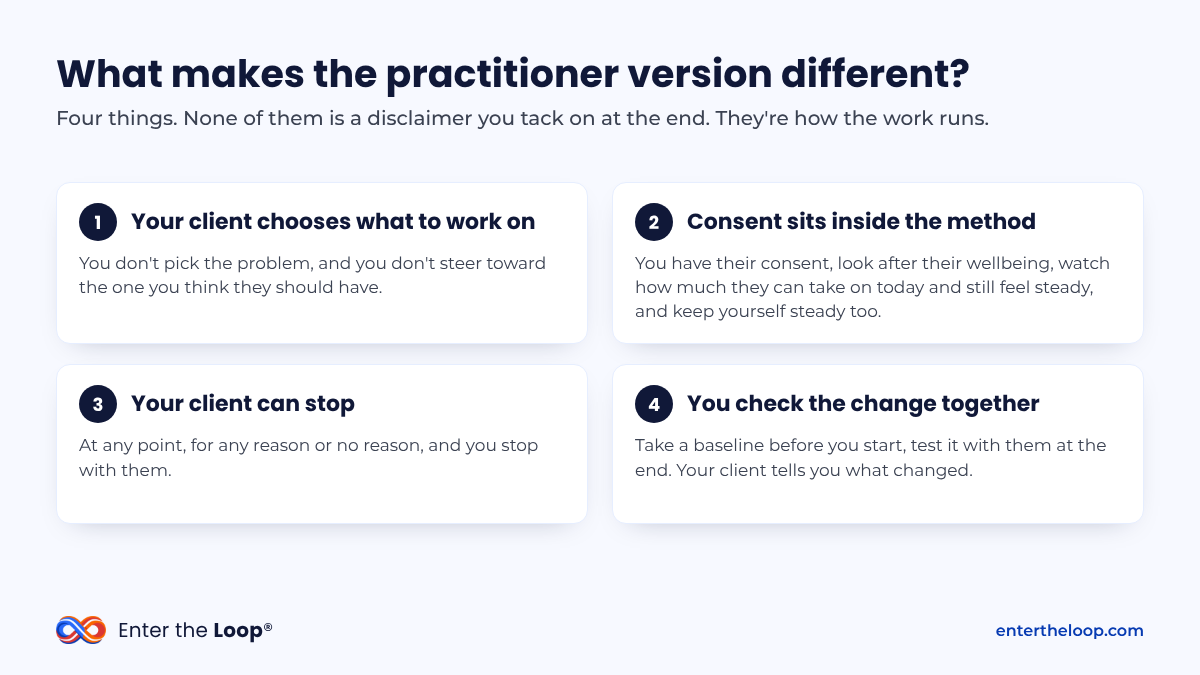
So the better question, for a practitioner, is what makes the way you work different. It comes down to four things, and none of them is a disclaimer you tack on at the end. They're how the work runs.
What makes the practitioner version different?
- Your client chooses what to work on. You don't pick the problem, and you don't steer toward the one you think they should have. Nicholas Heger, our Lead Mentor, put it this way: "we don't do anything to the person. They utilize whatever they give us. Even if we have an idea where it's probably gonna go, we don't lead them there."
- Consent sits inside the method. In Enter the Loop® we call this Keep It Clean. In plain words, it means four things: you have your client's consent, you look after their wellbeing, you watch how much they can take on today and still feel steady, and you keep yourself steady too. We teach it in the first three weeks of the course, before the Loop work and LORRA, because everything else rests on it.
- Your client can stop. At any point, for any reason or no reason, and you stop with them.
- You check the change together. Before you start, you take a baseline: how the problem shows up for your client right now, in their own words. At the end you test it with them. The soft test looks ahead: you ask them to think about the next time the original problem would come up and notice what's different. The hard test brings it into the room: you ask them to bring it up as if it's happening right now. Your client tells you what changed. You don't decide it for them. (There's more on this in how do you know if hypnosis worked?)
That last one matters more than people expect. Manipulation depends on the practitioner deciding what happened. When your client does the checking, they decide, and you both hear it.
What does consent look like inside a session?
When I was new to hypnosis, before my wife and I were married, I kept trying hypnosis stuff on her friends without asking them first. She hated it, and her friends kept asking her why I was trying it on them. I learned really quick what that meant. Ecology first: the whole person's wellbeing, their consent included, comes before any technique.
These days I'm never going to try to fix somebody's problem without them giving me consent to do so. Even outside a session, I'll usually ask up front, "Did you want to talk about it, or did you just want me to listen?" A lot of people just want to be heard, and that question lets them tell you.
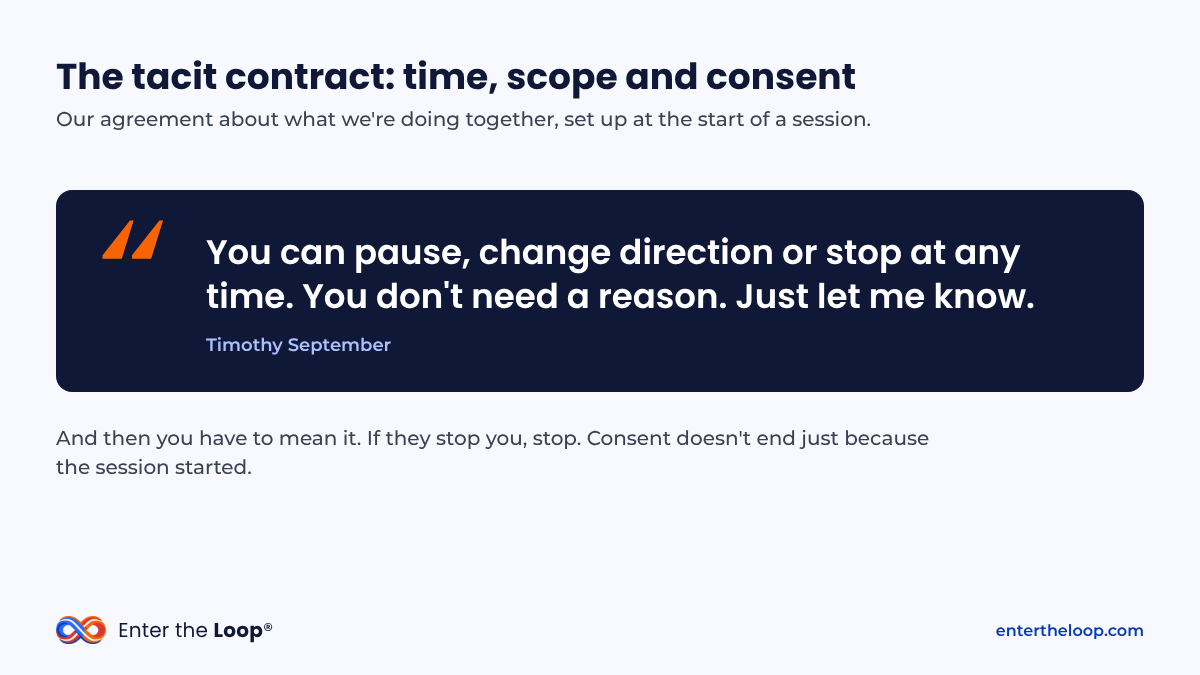
In a session, it's less formal than people expect. At the start I set up something called a tacit contract, which is our agreement about what we're doing together. It has three pieces: time, scope and consent. I'll tell my client something like, "You can pause, change direction or stop at any time. You don't need a reason. Just let me know."
And then you have to mean it. If they stop you, stop. No talking them back into it. Consent doesn't end just because the session started.
Before I go deeper into something, I ask again, in plain words: "Do you mind if I ask you a really strange question?" I also tell clients up front that I may ask questions they wouldn't usually get asked by a friend or a family member, and that there's a reason for each one.
Nicholas teaches two lines on this that are worth holding onto. The first: "Permission is not clean if you ask and then keep pushing anyway." The second is about timing: "The idea is ask before you reach that spot, whatever it is. Not when you reach the spot, before you reach that spot."
What stays in your client's hands?
Underneath a lot of searches is one question: can hypnosis make a person do something they don't choose? Plenty of those searches are typed by people who are scared. So here's the plain answer: in general, no. Hypnosis can't make a person choose a change they don't want.
John Ryder, Ph.D., writing on his Psychology Today blog, Hypnosis: The Power of Trance, in 2015, took up the question "Could you be hypnotized and forced to do something illegal or diabolical?" His answer: "The general answer is that you cannot." He also writes, "Hypnosis can be persuasive, but does not give the hypnotist control over your mind, morality, or judgment."
That matches what I teach. Your client's critical faculty (the part of them that weighs what you say) can come back online at any moment, and if what you say breaks their trust, the trance breaks with it. And I'm firm about one more line: we never put doubt into a person's worldview, whether that's their religion, culture, orientation or gender identity. Absolutely not.
So to be clear about what we do and don't teach: Enter the Loop® doesn't teach covert use. It teaches practitioners to work with a client who has chosen to be in the room, on something that client chose.
What do you say to a client who's worried about this?
How many of you have had a client ask whether you're going to take over their mind, half joking and half not? That's okay. It's a fair question. Maybe they've seen a stage show, or read the same encyclopedia entry you did.
I want you to answer it plainly, in a sentence or two. Something like: "No. You choose what we work on, and you can stop any time. I'll ask before we go deeper, and at the end we'll check together whether anything changed."
Then do exactly that. The answer only works if the session matches it. And if your client wants to read more, you're welcome to send them this page.
How do you know you're staying on the right side of the line?
A few questions you can ask yourself after any session:
- Did your client choose what you worked on, or did you choose it for them?
- Did you ask before going deeper, and did you listen to the answer?
- If they hesitated or said stop, did you stop?
- Were your questions open, or did they hide a right answer inside them? Nicholas calls that kind of question manipulation through clever questioning, and he's clear about it: "That's not what we do."
- Did you check the change together, or did you decide it worked?
If each answer lands on your client's side, you're working with your client. If one of them makes you wince, that's useful too. It's the thing to bring to practice, or to someone who can watch you work.
If you're newer to all of this, start with what conversational hypnosis is, for practitioners. It covers how it differs from formal hypnosis and what it can't do.
FAQ
Is it ethical to use conversational hypnosis with clients?
It can be, when consent is part of how you work. Your client chooses what to work on, knows they can stop, and checks the change with you at the end. Where it stops being ethical is when the practitioner decides the goal, keeps pushing after a no, or claims a result the client didn't confirm.
Do I need to tell my client what I'm doing?
Your client should know what kind of session they're in and what you'll be doing together. I tell people up front that I may ask questions that sound unusual, and that there's a reason for each one. What you're required to disclose can vary by where you practice and by any license you hold, so check the rules that apply to you.
Can my client stop partway through a session?
Yes. Tell them at the start that they can pause, change direction or stop at any time, with no reason needed. Then honor it when they do, without talking them back into it. Consent doesn't end just because the session started. Stopping early isn't a failure. It's your client using the choice you gave them.
What won't Enter the Loop® teach?
Enter the Loop® doesn't teach covert use, and it doesn't teach ways to get a person to do something they haven't chosen. It teaches practitioners to work with a client who chose to be there: listening for their words, asking questions that leave them room, and testing the change together so you both know whether it held.
Sources
- John Ryder, Ph.D., "Is Total Mind Control Possible?", Psychology Today, September 24, 2015: https://www.psychologytoday.com/us/blog/hypnosis-the-power-trance/201509/is-total-mind-control-possible
- Wikipedia, "Covert hypnosis" (read November 16, 2026): https://en.wikipedia.org/wiki/Covert_hypnosis
About the author
Timothy September created Enter the Loop®, a conversational hypnosis training for coaches, hypnotists and therapists. 160+ practitioners trained in Enter the Loop®. 1,000+ students taught, including 4 years as Head of Coaching at Mike Mandel Hypnosis.
At the free Open Session (on Zoom, the third Friday of every month, 1 to 3 PM ET), you can see this work done live. When a volunteer works with me, they get a check-in first, choose what they want to work on and can stop at any time, and at the end of their turn I check with them, live, whether anything changed. Camera off is fine. If you'd like to go further after that, the plans are at entertheloop.com/join. I look forward to seeing you there.
See this work done live, with a real person, at the free monthly Open Session on Zoom.


