
How do you know if hypnosis worked? A practitioner's test
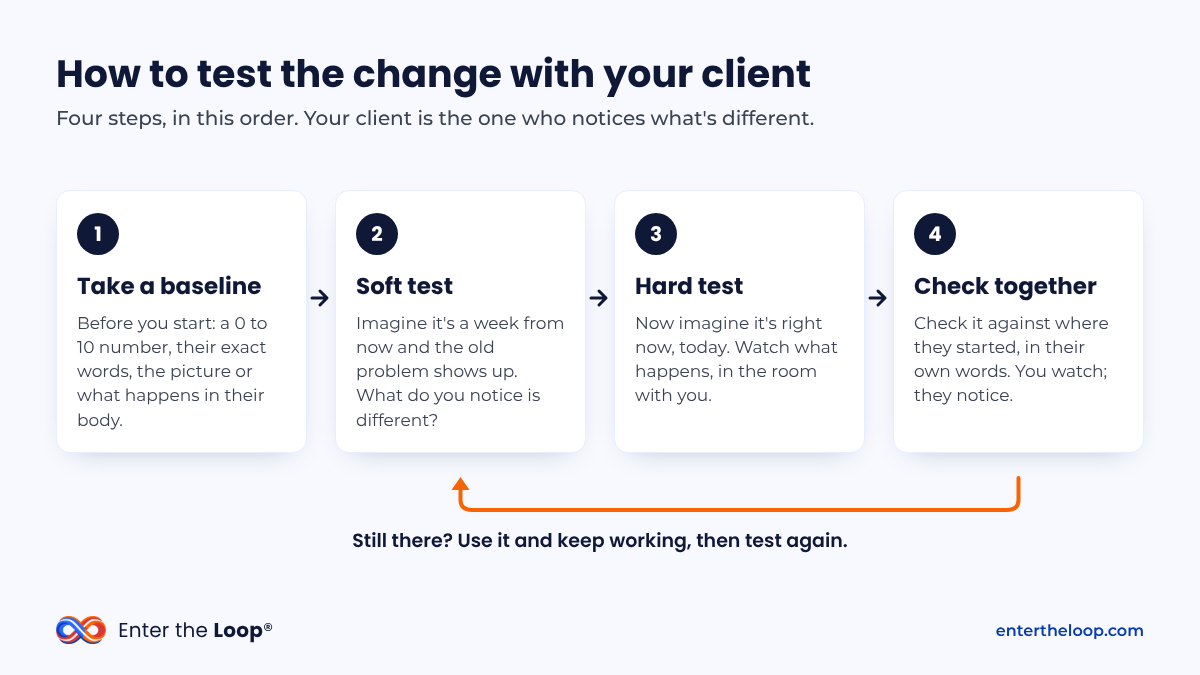
You know hypnosis worked when your client meets the original problem again and responds differently, and you both notice it. So take a baseline before you start. Then run a soft test (the problem a week from now) and a hard test (the problem right now, in the room), and check the difference together.
Have you ever finished a session, watched your client open their eyes and smile, and then driven home wondering if anything happened at all? That's okay. I've been there too. This post is for the practitioner, the one doing the work, and it's how I check.
Can trance signs tell you the hypnosis worked?
No. They tell you something else, and it's still useful.
When you search this question, most of what comes up is a list of trance signs: the eyelids flutter, the breathing slows, the face goes still, the client takes a long pause before they answer. I teach my students to watch for signs like these. They tell you your client went inside to look at something. That's good information. What they don't tell you is whether the problem changed while they were in there. A person can go very deep and come back up with the problem exactly where they left it.
The same goes for the question most of us were taught to ask at the end: "So, do you feel better?" Better than what? If you never asked how bad it was at the start, neither of you has anything to compare against. Your client will usually be kind and say yes. And you'll go home with a kind yes and no idea what it means.
Nicholas Heger, our Lead Mentor, puts it this way to students: "just because there's a shift doesn't mean you're done, but you could be completely ready to close it out and not even know it." A shift is something to notice, and then something to test.
Was it real, or was my client just playing along?
You find out by testing it with your client, not by reading their face. And if you've ever wondered this, you're in good company.
I've had a session where the client told me they didn't feel the shift they wanted. And I was going, oh man, I don't know if I can do this. Was it the technique? Was it the client? Was it me? I carried that doubt into the next session, switched techniques, and doubted myself even more. That spiral is a big part of why I moved to a conversation-first way of working, and why testing is a required part of how I teach students.
Testing takes the guessing off your shoulders. You stop reading your client's face to decide whether it worked, and you let them check the problem against where they started. The test isn't your quiz of them. It's theirs. You set it up, you watch closely, and they're the one who notices what's different.
At the start, when you ask your client whether they're ready to work on it today, what you're looking for is a real yes, not a polite one. No test reads your client's mind. But a client checking their own problem, in their own words, against their own starting point, is a lot harder to play along with than "do you feel better?"
What should you measure before you start?
You measure the problem itself, in your client's terms, before you do any work on it. That's your baseline.
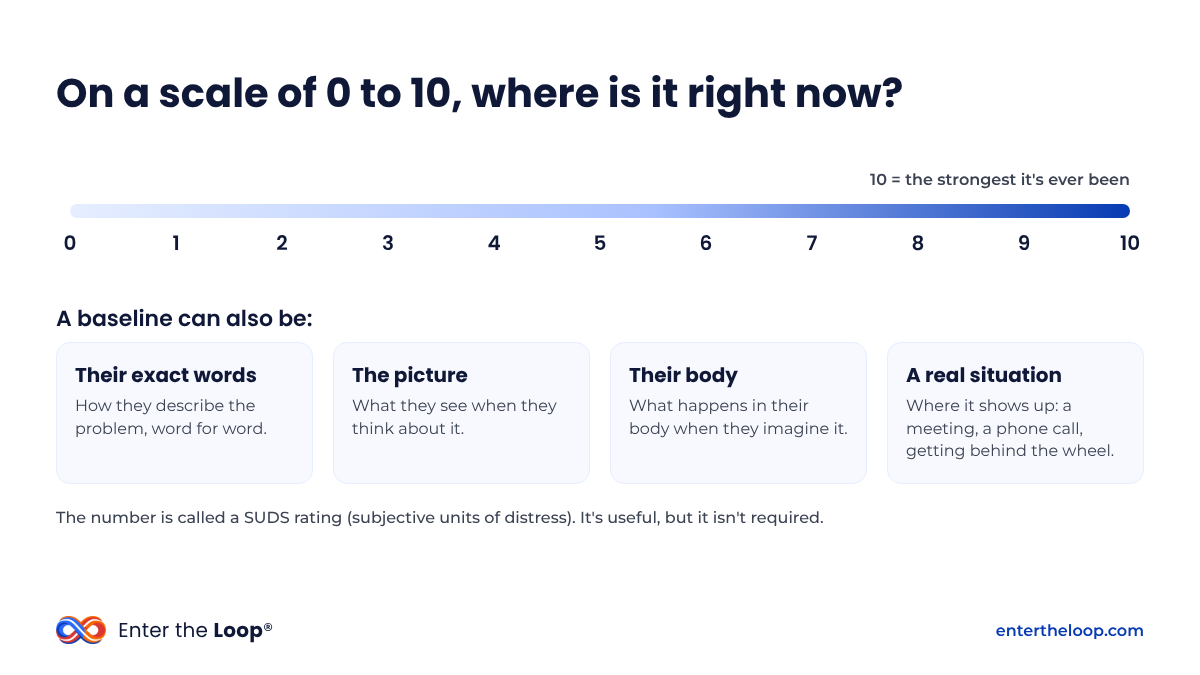
Start with two questions: what are we working on today, and what would you like to have happen? Use their exact words back, then give them silence to talk. Once you know the problem, take a baseline. Usually that's a number. On a scale of 0 to 10, where 10 is the strongest it's ever been, where is it right now? That's called a SUDS rating (subjective units of distress).
The number is useful, but it isn't required. A baseline can also be:
the exact words they use to describe it
the picture they get when they think about it
what happens in their body when they imagine it happening
a real situation where it shows up, like a meeting, a phone call or getting behind the wheel
I want you to ask yourself one question at the start of every practice session: if this were a full session, what would I test at the end? If you can answer that, you started well.
What is a soft test?
A soft test checks the change in the future, with the original problem.
Once you notice something has shifted (they talk about the problem differently, their hands move differently, their breathing changes), you invite them a little way into the future. Something like: "Now I want you to imagine it's a week from now, and that thing that used to bother you happens again. What do you notice is different?"
Say the problem was getting behind the wheel. A week from now, you walk up to the car door. What do you notice is different?
Ask what's different, not what's still bothering them. That sends their mind looking for the changes, and it gives you feedback you can repeat back to them. Then you listen and you watch. When I teach it, I put it simply: I future pace, and then I just see and calibrate.
What is a hard test?
A hard test checks the change as if the problem is happening right now, in the room with you.
After the soft test, I bring it into the present: "Now imagine it's right now. It's today." You're no longer asking about next week. You're bringing the thing that used to bother them into the conversation and watching what happens, against the number or the words they gave you at the start.
This is the part that can feel risky. I'd rather my client show me any leftover distress in the room, where we can work on it right away, than have them leave and I find out months later. I usually run the soft test first and the hard test second. Both of them belong to the client.
What if the test shows the problem is still there?
Then you've learned something true, and you're back in the loop.
If your client says, "I still kind of feel some stuff," don't argue with it and don't panic. Use it. "Yeah, you feel some stuff. What is it, specifically, that you feel?" That often opens another layer of the same problem, and you keep working.
If you're out of time, close honestly. Name what's still there, help them end the session steady, and plan the next step together. Don't tell them it's finished when it isn't.
How do you check the change held after the session?
You check it the next time you see them, and you let real life be the final test.
I really believe change work comes down to one thing: when that old thing shows up again for the person, can they respond differently? So at the next session, I check in with the problem, and I put it in the past tense. "That old thing we talked about. Is it still there?"
When a problem has spread into several areas of someone's life, I might check in with them on and off over a couple of months, and test how things are going each time. Testing doesn't promise anything about next month. It tells you both where things stand today, and it tells you where to go next.
Where can you watch the check happen live?
At the free Enter the Loop® Open Session. It's live on Zoom on the third Friday of every month, 1 to 3 PM ET. You'll find the next date on the Open Session page.
Volunteers get a check-in first, choose what they want to work on, and can stop at any point. When I work with a volunteer, I check live at the end of their turn, with them, whether it changed. The main room is recorded, recordings are emailed as a replay and may be shared publicly later, and breakout rooms aren't recorded. Volunteers are in the recording. If your camera is off and you don't speak, your face and voice won't be in the recording.
If you want the bigger picture first, read what conversational hypnosis is or what Enter the Loop® is and how a session goes. And if you already know you want to practice with us, you can see the plans.
Questions practitioners ask about testing
Do I have to use a 0 to 10 scale?
No. I take a SUDS number in nearly every session as a gauge, but it isn't required. Clear feedback from your client ("I feel lighter," "something shifted") plus what you see in their body is enough. What matters is that you have some baseline from the start of the session, in their terms, so the test at the end has something real to compare against.
Can a hard test bring the problem back?
It can show you the problem isn't finished, which is the point of doing it while your client is still with you. If distress shows up, you notice it, you name what you saw, and you go back to work, or you help them end steady if you're out of time. Safety comes first. If something big shows up, stay with them and keep them steady before anything else.
Does a good test mean the change will last?
No test can promise that. A good soft test and hard test tell you the change is there today, checked by your client and seen by you. Whether it holds out in their life is something you find out together: the next time the old trigger shows up, and the next time you talk. That's why you check in again, in the past tense, at the next session.
What if my client says "I don't know" during the test?
Don't push. Give them a moment of silence first. Then you can say it back: "You don't know." And if they still need a nudge: "If you did know, what would it be?" That gives them room to find their own answer instead of hunting for the right one to please you. Whatever they come back with tells you where to go next.
See this work done live, with a real person, at the free monthly Open Session on Zoom.
About the author: Timothy September, creator of Enter the Loop®, a conversational hypnosis training for practitioners. 1,000+ students taught, including 4 years as Head of Coaching at Mike Mandel Hypnosis.


