
What is Enter the Loop®? Conversational hypnosis training
Enter the Loop® is a conversational hypnosis training for practitioners, created by Timothy September. You learn to notice the loop your client is already running, step into it with them in a conversation your client chooses to have, and test the change together, so you both know whether it held.
Who is Enter the Loop® for?
It's for people who already help others change: hypnotists, hypnotherapists, coaches and NLP practitioners, plus licensed clinicians who want to add conversational work to what they already do.
Many of the people who come to it have done general hypnosis training first. They can find the problem in a conversation. What they want is to change it there, live, with a real person in front of them, and to know afterward whether it worked. Enter the Loop® builds on the training you already have. It doesn't ask you to throw it out.
It isn't for people who want to change someone who hasn't asked for it. If that's what you're looking for, this isn't the training for you.
What is the Loop?
The Loop is the pattern a person is already running when they come to you with a problem: a belief, which fires an image, which fires a response in the body, which becomes their experience, which feeds the belief again. It runs on repeat, all day.
The model comes from James Tripp's Hypnosis Without Trance (belief, imagination, physiology, experience). Timothy builds on it and calls the client's version the Problem Loop. In his words: "when people come to you with a problem, they're already in hypnosis. They are in their own loop…"
So instead of putting your client into a new state, you notice the loop they're already in and work with it, together. You can step in at any point in the loop: what they believe, what they picture, what they feel in their body, or what they live through.
How does an Enter the Loop® session go?
A session follows the same arc each time, in plain conversation with your client. Your client picks what to work on.
- Listen for the doorway. A doorway is a charged moment in the conversation where something stands out: a word your client keeps coming back to, a change in their breathing or hands, or a part of them that speaks up, like the part that wants to and the part that doesn't. Asking about that moment is how you get into the loop underneath it.
- Enter with your client. You ask before you go deeper ("Can I ask you some weird questions?"), and you ask again when the work gets heavier. You stay with their words, their images and their pace.
- Run LORRA. LORRA is the conversational engine of Enter the Loop®: Listen, Observe, Repeat, Relate, Ask. You listen for what matters to them, watch how they respond, repeat their exact words, relate two things they've said, then ask one question and wait. Each pass lets your client go a little further inside.
- Keep It Clean. This runs through the whole session. It covers consent, your client's wellbeing (what we call ecology), how much they can explore and still feel steady, and your own steadiness. At each step you choose: continue gently, steady things first, or don't go on as planned.
- Test the change. Before the session ends, you check the change against the original problem, together. First a soft test: imagine it's a week from now and the old problem shows up, so what's different? Then a hard test: bring it into the room as if it's happening right now, and watch what happens. If something's still there, you're back in the loop.
What Enter the Loop® isn't
It isn't covert. Your client knows what you're doing and chooses what to work on. Consent is part of the method, taught in its own week, and your client can stop at any point.
It isn't a script library. Enter the Loop® teaches a model and principles you can use with a real person, and real people tend to go off script fast. There's no script for a problem because you work with the material your client brings.
It doesn't offer CE credits. If you're a licensed clinician, please know that Enter the Loop® doesn't offer CE credits today.
It isn't therapy or medical care. Enter the Loop® is skills training for practitioners. If someone brings you a medical or mental-health condition and your license doesn't cover it, refer them to someone whose license does.
It isn't a promise of results. You learn the method and how to test it with your client. What happens in a session depends on the practitioner, the client and the practice put in.
It isn't private sessions. No plan includes private 1:1 sessions with Timothy.
Who teaches Enter the Loop®?
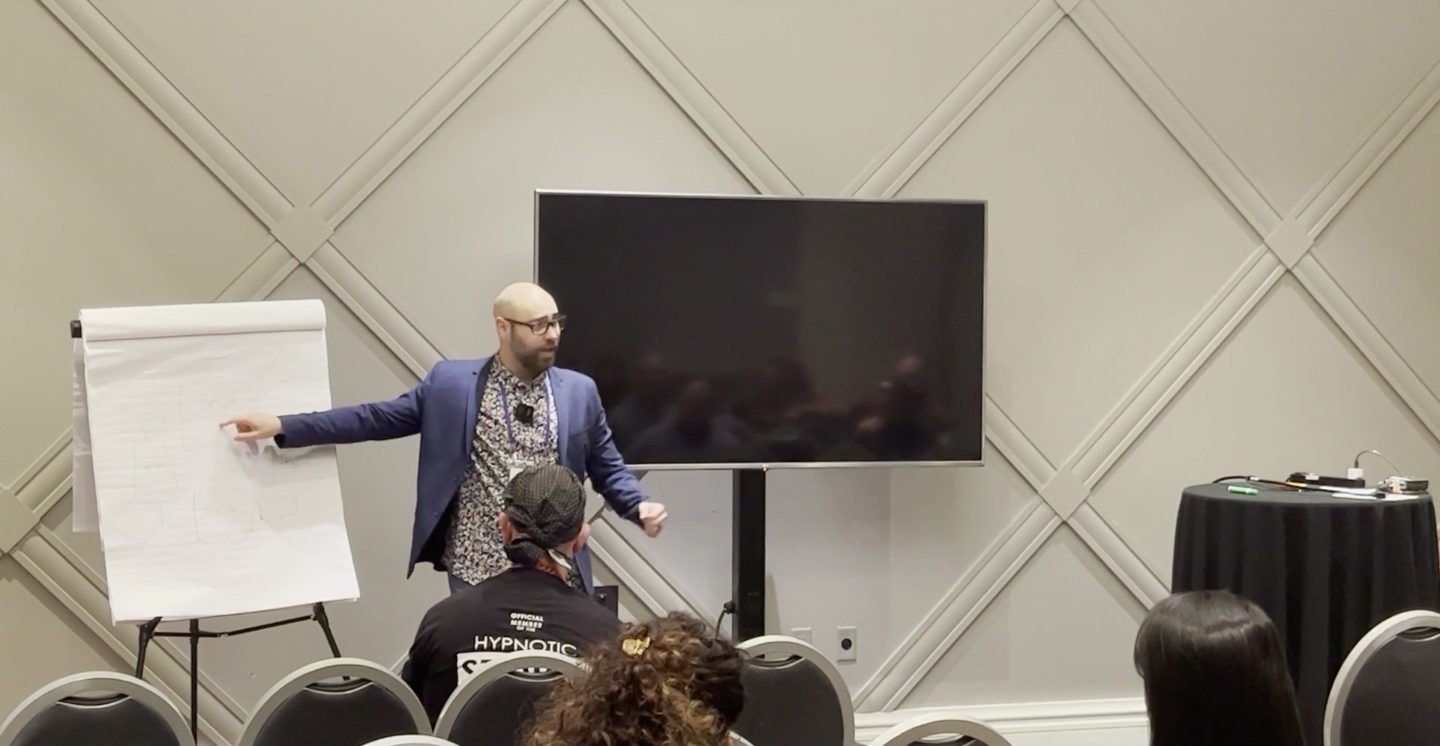
Timothy September created Enter the Loop® and is its lead instructor. He teaches the self-paced course, leads Foundations Live and runs Timothy Time.
Nicholas Heger is the Lead Mentor of Enter the Loop®. He rebuilt the course into its current version from Timothy's material, organizing the lessons, designing the step-by-step practices with their tasks and objectives, and rebuilding the curriculum and quizzes. He also runs the Mentor Room, where he watches members practice and gives feedback to the ones who want it.
- 160+ practitioners trained in Enter the Loop®
- Timothy September: 1,000+ students taught, including 4 years as Head of Coaching at Mike Mandel Hypnosis
- 15 years of private practice between Timothy (10) and Nicholas (5)
The work stands on other people's shoulders, and Timothy names them: James Tripp for the Loop model, David Grove's Clean Language as taught by Wendy Sullivan and Judy Rees, and Milton Erickson's idea of using what the client already brings.
How can I see it before I join?
Come to the free Open Session. It's live on Zoom on the third Friday of every month, 1 to 3 PM ET. Volunteers get a check-in first, choose what they want to work on and can stop at any point. At the end of a volunteer's turn, Timothy checks with them, live, whether it changed. The main room is recorded, recordings are emailed as a replay and may be shared publicly later, and breakout rooms aren't recorded. Volunteers are in the recording. If your camera is off and you don't speak, your face and voice won't be in the recording.
You can also watch a full, unedited session, with the setup left in. It plays for a while, then asks for your name and email to keep watching.
When you're ready to look at the plans, they're all on the plans page.
Questions people ask about Enter the Loop®
Is Enter the Loop® covert hypnosis?
No. Covert hypnosis means trying to change someone who hasn't agreed to it, and Enter the Loop® doesn't teach it. Timothy puts it plainly: "I'm never going to attempt to fix somebody's problem without them giving me consent to do so." It feels like a natural conversation because it is one, and your client chooses what to work on, says yes before you go deeper, and can stop at any point.
What if faith matters to me or to my client?
Enter the Loop® doesn't ask you or your client to take on any faith or worldview, and it doesn't question the ones your client holds. The work follows your client's own words and worldview. Timothy teaches it plainly: "we never want to inject doubt on a person's worldview in terms of, you know, religion, culture..." Your client chooses what to work on and can stop at any point.
How do I practice what I learn?
In Peer Practice. Members practice on each other, at least twice a week. A volunteer member opens the room. There's no teacher in it; for a mentor watching you work, that's the Mentor Room. The Mentor Room is on the Annual Pass, twice a week with Nicholas Heger. A course can teach you the method. It can't watch you work.
Do I need hypnosis training first?
No. You don't need prior training, though most members have some, and the method builds on whatever you already bring. Start with the self-paced course and come to Peer Practice once you've done the first weeks.
Does my client need to close their eyes or go into trance?
No. In Enter the Loop®, there's no switch into a separate "hypnotist mode," and, in Timothy's words, no "close your eyes, sleep now." Your client stays in the conversation, and whatever trance shows up comes from them going inside to think about their own experience.
How do I know if it worked?
You test it with your client. You take a baseline at the start, often a 0 to 10 rating or their own words for the problem, then run a soft test (the problem a week from now) and a hard test (the problem right now, in the room). Your client notices what's different, and you watch. Read more about testing the change.
Does Enter the Loop® offer CE credits or a certificate?
It doesn't offer CE credits today. Foundations Live, the 10-week live cohort taught by Timothy, ends with an evaluation to become a Certified ETL Practitioner: you submit a recorded session, it's evaluated against the course standards, and you can resubmit if it isn't there yet. Passing isn't guaranteed, and the certification isn't a license or a state credential.
What are the plans?
There are three. Monthly gives you the self-paced course, the Vault of recorded sessions, the community, the monthly live Q&A with Timothy and Peer Practice. The Annual Pass adds Timothy Time and the Mentor Room. Foundations Live is the 10-week live cohort, and it includes a year of the Annual Pass. Prices and details are on the plans page.
Is it the same as Hypnosis Without Trance?
No. Enter the Loop® uses James Tripp's Hypnosis Without Trance model (belief, imagination, physiology, experience) as the map of the client's loop, and credits him for it. Around that map, Timothy built his own method: listening for the doorway, LORRA, Keep It Clean and testing the change with your client.