
Hypnotherapy Without Scripts: What to Listen For Instead
Hypnotherapy without scripts means working from what your client actually says, instead of from a page written before they sat down. You listen for their exact words, notice the moment something carries charge (the doorway), follow the loop they're already running, and then check the change with them against the original problem.
This one is for practitioners with scripts in the drawer who wonder what to do when a client doesn't follow along.
What happens when your client goes off the script?
So you've got the script ready, and you know where the pauses go. Then a couple of minutes in, your client says something that isn't on the page. They bring up their sister. They laugh at a strange moment. They tell you the problem isn't really the problem.
Have you ever felt your stomach drop right there? Do I keep reading? Do I stop? Do I switch to a different script?
It's a really common moment for people who learned from scripts first.
Are hypnosis scripts bad?
No. Scripts are a solid foundation, and a lot of us learned that way. That training gave you language, structure and enough confidence to start. I'm not asking you to get rid of what you know.
The trouble starts when the script is the only thing you have and a real person moves. Your client says "anxiety," and we go straight to the anxiety script or the anxiety protocol. But that word doesn't mean the same thing to every person. You've skipped the step where you find out what it means to this one.
Thinking about your client ahead of time is fine. Hunting for the right script before every session is different. Some people find it helpful, but for most of us it makes us more unprepared than prepared.
When I was putting Enter the Loop® together, the thing I wanted most was for it not to be a hammer-and-nail situation, where you learn a thing and can only use it in one situation. The questions I ask are usually the same, because they're clean and they came out of years of trial and error. Use them as a starting point, with room for your own tone.
What do you listen for instead of a script?
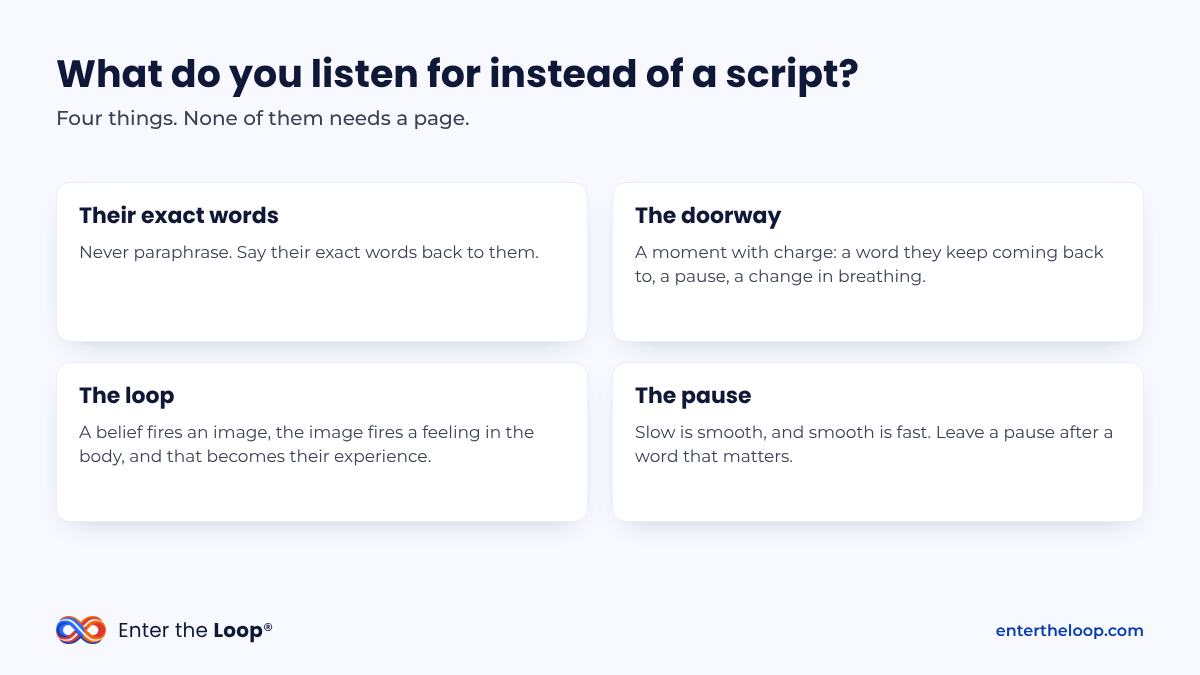
Four things. None of them needs a page.
Their exact words
The first principle I teach is never paraphrase. When your client tells you something, say their exact words back to them. Some trainers will tell you to put it in your own words so they know you're listening. I teach the opposite. If they said "drowning" and you say "overwhelmed," you've swapped in your meaning for theirs, and that can cost you rapport.
So when they say, "I'm drowning in it," you might say, "Drowning. Tell me more about that."
The doorway
Some moments carry more charge than others: a word they keep coming back to, a pause, a hand moving, a change in breathing, or "Part of me wants to and part of me doesn't." That's what we call a doorway: one place where you can step into what's going on underneath. "Part of me doesn't" isn't a stop sign. It's an invitation to get curious.
Nicholas Heger, our Lead Mentor, puts it like this: "The first label is rarely the real problem or the whole loop." The first thing your client names is where they start. Follow it, rather than treating it as the answer.
The loop
Every person is already running a loop. A belief fires an image, the image fires a feeling in the body, and that becomes their experience, over and over. That map comes from James Tripp's Hypnosis Without Trance: belief, imagination, physiology, experience.
So when your client says there's a wall in front of them, there isn't a wall in the room. They're sitting across from you in your office, or on Zoom. They're picturing it, and that picture is what starts the feeling in their body. That makes the metaphor worth asking about.
A script can't hear any of that. It was written before your client said a word.
The pause
Slow is smooth, and smooth is fast. I learned that in the military, and it's one of the first things I teach. When you slow down and leave a pause after a word like "success," your client gets the chance to ask themselves: success with what? With who? Where? I definitely think slowing down is the way to go, especially when you're repeating and relating their words.
Why use a framework instead of memorized lines?
Enter the Loop® is built on models and principles, not scripts. A model is kind of like the framework of a house. It's the foundation. The principles are the pillars. They're what keep the roof up. The model is the frame you use to get results, and the principles are the rules that sit inside it.
A memorized line fits the moment it was written for. A framework comes with you into the next conversation, because it tells you what to do with whatever your client just gave you.
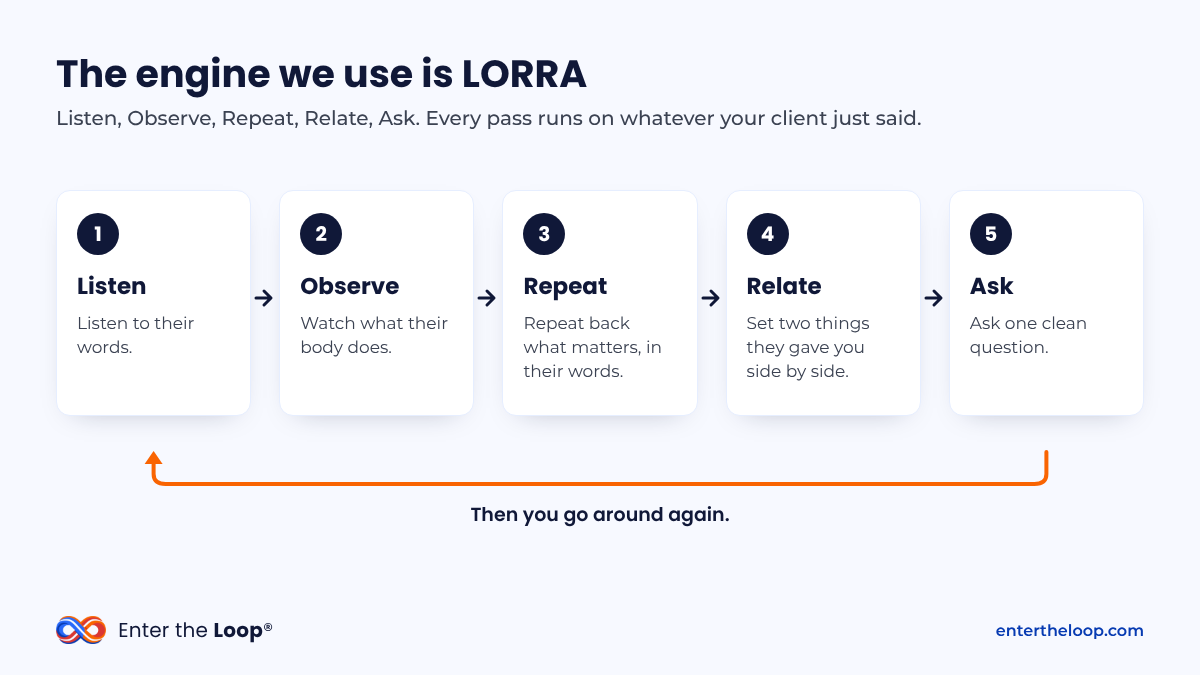
The engine we use is LORRA: Listen, Observe, Repeat, Relate, Ask. You listen to their words, watch what their body does, repeat back what matters in their words, set two things they gave you side by side, and ask one clean question. Then you go around again, and every pass runs on whatever your client just said.
There's a second reason. When the hypnotist or the coach thinks they're the one who has to fix it, they end up carrying the box of tools and techniques and scripts, and worrying about doing it right. This way of working is bottom up. The change comes from the client. Your job is to be curious about what they're saying and to listen and observe closely, instead of trying to fix it.
How do you check the change without a script?
You check it with your client. The session isn't done until you've both looked at the original problem again.
First, get a baseline. One simple way is to ask, "On a scale of zero to 10, where would you put this right now?" The number is optional. Clear feedback from your client, plus what you observe, can be enough.
Then, when you notice a shift, test it. We test twice:
- The soft test checks the future. "Imagine it's a week from now, and that thing that used to bother you happens again. What do you notice is different?"
- The hard test brings it into the room. "Now imagine it's happening right now, today. What do you notice?"
If your client goes back to the original problem and notices a difference, you both have something real to go on. If something is still there, that's useful. Say what you noticed, ask what it is specifically, and you're back in the loop. It may be the next layer.
Skip the testing, and someone can feel wonderful in the session and still find the old pattern waiting for them later. There's more on this in how you know if hypnosis worked.
What if you freeze without the script?
That's okay. Nerves still show up for experienced people, and freezing often comes from planning your next line while your client is still talking.
Here's what I want you to try. Keep the script nearby if it helps. When your client goes off the page, don't reach for it right away. Say their last important word back, pause, and see what they do with it.
Something changes when you stop planning. When I'm working with someone, at some point I notice I go into a kind of trance myself. I have no idea what I'm about to ask until it arrives in the moment, and I trust myself to ask it. That takes some practice.
Your client also chooses what to work on, and you ask before you go deeper. We call that Keep It Clean: consent, checking the person is okay, and working at their pace.
FAQ
Is hypnotherapy without scripts the same as conversational hypnosis?
They overlap a lot. Conversational hypnosis is changework done through conversation with your client, rather than a script read to them. Working without scripts is one part of that. You can drop the script and keep a formal induction, or bring a few prepared questions into a conversational session. What matters is that you follow what your client gives you. More on what conversational hypnosis is.
Do I need a formal induction?
Not always. In my experience, people can go very deep through conversation alone, and it doesn't depend on a formal induction. Slowing down, pausing, and asking about their own words and images tends to take them inward. A formal induction is still a perfectly good tool, and plenty of practitioners keep using one. Use whichever serves your client.
Should beginners still learn hypnosis scripts?
Yes, if that's how your training works. Scripts teach rhythm, language and structure, and they give you something to lean on while you build confidence. The goal is to stop needing them in the moment. Keep the questions that work, keep your own tone, and practise listening for what your client gives you.
What is a doorway in hypnosis?
In Enter the Loop®, a doorway is a moment with charge: your client repeats a word, pauses, their breathing or body shifts, or a part of them shows up ("part of me wants to"). Asking about it, in their own words, tends to open onto the loop underneath the problem. One good doorway is enough to start.
See it live
See this work done live, with a real person, at the free monthly Open Session on Zoom. When a volunteer works with me, they choose what to work on and can stop anytime, and at the end of their turn I check with them, live, whether it changed. Camera off is fine if you'd rather watch. It's on the third Friday of every month, 1 to 3 PM ET.
Ready for the course and the practice rooms? See plans and prices.
I look forward to seeing you there.
Timothy


